30 Mart 2009 Pazartesi

We’ve Lost the Vocabulary of Scripture

March 30, 2009 9:00 pm

We've Lost the Vocabulary of Scripture

Quoting Pastor Todd Wilken from the March 23rd Issues, Etc. segment on the Catechumenate with Dr. Kent Burreson:

Think about how the Scriptures describe the movement from unbeliever to believer. You know nowadays we just have this category "unchurched" and "churched." How barren, how empty, how hollow a way of thinking about the move from what Scripture says is "death to life," "enemy of God" to "friend of God," "sons of wrath" to "those who have been shown mercy," "kingdom of darkness" to "kingdom of light," and we in the modern Church say "churched" and "unchurched?" How vacuous. Maybe that's part of the problem.

We've lost the vocabulary of Scripture when it comes to the difference between the Church and the world. And having forfeited the vocabulary of Scripture in these things we think more like the world about these things. Well, it's just a sociological category, you're unchurched or your churched. And we are poorer for it. And in fact, we may be through our empty ways of bringing people into quote unquote membership or attendance into the twenty-first century Church not so much making Christians, or disciples, but simply making members, associates. What's another term that they might use, clients? Who knows. When the Scripture speaks of it as going from death to life, from being an enemy to God to being reconciled to God, sons of wrath to sons of mercy, darkness to light, it means that these are not just metaphors, these are the truth of what it means to go from unbelief to belief, from the world to the Church and the body of Christ. Do we need it? Of course we need it. And if we lose it, what we lose is perhaps the Church itself.

photo credit: monkeyc 2

Weakening Of Other People's Currency

March 30, 2009 8:59 pm

Weakening Of Other People's Currency

The new silver lining is that American travelers, if they have the money to spend, can strike a bargain with other people’s currency.

In Iceland, for example, the krona has tumbled as much as 45 percent (refer to graph). A South African safari costs some 30 percent less than it did last year. And in Estonia and the Ukraine, Americans can vacation like kings and queens.

Take a good look here.

Note: The graph above shows historical exchange rates between the Iceland Krona (ISK) and the US Dollar (USD) between 10/1/2008 and 3/29/2009.

28 Mart 2009 Cumartesi

On My Heart Imprint Your Image

March 28, 2009 11:10 pm

On My Heart Imprint Your Image


On my heart imprint Your image,
Blessed Jesus, King of grace,
That life’s riches, cares, and pleasures
Never may Your work erase;
Let the clear inscription be:
Jesus, crucified for me,
Is my life, my hope’s foundation,
And my glory and salvation!

LSB # 422

photo credit: Loci Lenar

There is No Lack of Business Model Innovation Ideas

March 28, 2009 11:09 pm

There is No Lack of Business Model Innovation Ideas

Currently I am working our upcoming book “Business Model Generation” on a section about ideation: the art of generating innovative business model ideas.

While working on this section I realized that ideas were not necessarily the problem. They exist in abundance within a company or an industry. I’ve experienced this with multiple organizations. The issue is selecting the right ideas, turning them into something implementable and then actually DOING them.

Regarding the first issue, selection, the biggest problem is that today’s organizational and management structures don’t allow good business model ideas to become visible. Interesting business model ideas can come from anywhere in a company. Operations, client services, finance… Yet, they have to be selected by management in order to maybe become real options. More often than not they stay invisible. I’m pretty sure that there were many smart folks in record companies that had good busines model innvation ideas. However, the management of these companies preferred to stick to the status quo… and ultimately become disrupted by illegal downloads and challenged by iTunes.

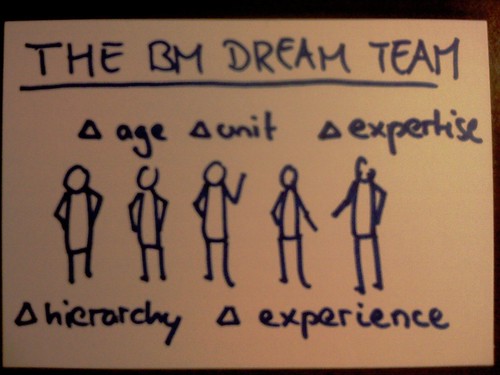
A solution to this is to put a multi-disciplinary business model innovation task force together. One that has the sponsorship of top management and the board. The task force should be composed of people from various levels of hierarchy, from different age groups, with diverse levels of experience, from different business units and with mixed expertise. The diversity will help ideas to emerge, to be discussed, improved and then selected for implementation.


The implementation issue is more challenging. It requires the willingness of top management and the board to experiment and allow for bottom-up ideas to emerge. Unfortunately, it also requires taking some risks to play with new ideas in the field. But if you look at the major record companies today, the risk of inaction is even bigger. I would argue for maintaining a portfolio of business models of which some may even cannibalize the existing main business model.

A great example of a business model portfolio can be found within Nestlé’s coffee business. While the Swiss multinational became big in coffee with Nescafé it’s current growth engine is now Nespresso. Nespresso sells espresso machines and pods to the high-end of the market. What is impressive is that Nestlé is internally challenging its new multi-billion espresso-pod money-making machine. They expanded their business model portfolio in coffee with Dolce Gusto, a Nescafé sub-brand targeting the lower end of the market. Dolce Gusto’s business model is quite similar to that of Nespresso with some tweaks. Nespresso sells to the higher end of the market, while Dolce Gusto sells to the lower end. Nespresso doesn’t sell pods through third party retail, while Dolce Gusto does. Though they are both targeting different customer segments, Dolcé Gusto is still cannibalizing Nespresso to a certain extent. Respect for Nestlé that they allow for this internal competition!

Globalization Is Here To Stay

March 28, 2009 11:09 pm

Globalization Is Here To Stay

Globalization is much, much more than international trade and investment. It’s about connectedness and global activities.

Quick quote:

Still, the current wave of globalization has many unprecedented characteristics. As Internet access penetrates the most remote corners of the globe, it is transforming the lives of more people, in more places, more cheaply than ever before—and the pace of change is accelerating faster than we can hope to chronicle it.

Read the interesting essay (that includes the above quote) about this notion in Foreign Policy, “Think Again: Globalization.”

26 Mart 2009 Perşembe

Disrupting the Music Industry: Trent Raznor

March 26, 2009 10:07 pm

Disrupting the Music Industry: Trent Raznor

Many of you have seen my presentation “business models matter“, which shows how the music industry has been slow to react to a changing industry landscape.

Here a video explanation by Mike Masnick from Techdirt of how an artist, Trent Raznor, is re-inventing business models for the music industry. Most interestingly: he shows how FREE can be the basis for earning substantial revenues…

What can other industries learn from this? I have a pretty clear idea: Business Model Innovation is possible!

The Silly Business Model Innovation Cow Exercise

March 26, 2009 10:07 pm

The Silly Business Model Innovation Cow Exercise

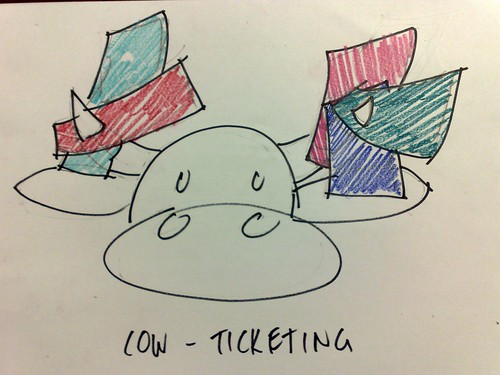
A couple of posts back I wrote about a simple, fun, but silly exercise to think out of the box when it comes to business model innovation: the silly cow exercise. I asked people to submit their own sketches of business models using a cow..

The echo was very weak (no creativity out there, or fear of sketching?). Hence, in addition to the set of sketches I got from Fréderic Sidler, I photographed some of the sketches coming out of a workshop I did last week in Belfast. The silly cow exercise is a always a success, probably because it looks at business model innovation from a very light angle. It even works with very senior and serious business people. My favorite business model came from a participant in Belfast. However, she didn’t have the courage to present her sketch during the workshop: “The Condom Tester”…

Here some of the sketches. You can find the full set on Flickr. I will certainly add more over time…

Financial Crisis - an Opportunity for Business Model Innovation?

March 26, 2009 10:07 pm

Financial Crisis - an Opportunity for Business Model Innovation?

Innovating during an economic downturn might seem counter intuitive at first sight. However, it is precisely the right moment to do so, as long as you already prepared your company for survival during this extremely severe crisis.

This Monday European and US companies announced a brutal 76′000 job cuts in one single day (cf FT article Gloom deepens as 76,000 jobs go in a day). To focus on business model innovation when you just fired a part of your workforce to bring your company through the crisis might seem very strange. Yet, it is the right moment to do so for a number of reasons.

Business model innovation is difficult to achieve because it affects so many parts of an organization and because it needs the buy-in of so many different people. In addition, it requires the right organizational structures and a sense of urgency to make it happen. All these conditions are, unfortunately, easier to achieve during an economic downturn.

In an economic crisis complacency is gone and everybody feels a sense of urgency to act. People resist change much less when the survival of their company and ultimately their jobs are at stake. We all know how fiercely most people resist change in good times. So when the most urgent issues, such as cash management, are taken care of, a company’s management should turn to innovation. This is the best opportunity they will get to position their company for the future of business model innovation.

So what is to be done? A good place to start with is building the right organizational structures that allow for business model innovation. With this I don’t simply mean a “traditional” restructuring and shifting of people, but deep structural change. An organization that systematically wants to address business model innovation has the following characteristics:

  • its board explicitly gives the management the mandate to continuously examine business model innovation;
  • it extensively works with multidisciplinary teams across “departments” and across hierarchies;
  • it has mechanisms that allow innovative business model ideas to be evaluated by peers during a first phase, rather than “just by managers”;
  • it involves the customer in the process of business model innovation
  • it maintains a portfolio of innovative business models that may even cannibalize the existing business model.
  • it has the right physical space in place to allow multidisciplinary business model project teams to flourish. In other words, it has project/war rooms dedicated to a project during it’s entire duration and with lots of whiteboards and walls to post visuals.

Voilà, some “unbaked” thoughts on using the economic downturn as an opportunity to position an organization for the future of business model innovation.

If you have any thoughts to add, please don’t hesitate. The forum is yours…

Business Model Designer From Sticky Note To Screen Interaction

March 26, 2009 10:07 pm

Business Model Designer From Sticky Note To Screen Interaction

Last Friday I was part of the committee for a Masters Thesis defense on business model design at the HEC Business School in Lausanne, Switzerland. Boris Fritscher, whom I previously mentioned on this blog, defended his thesis “Business Model Designer From Sticky Note To Screen Interaction”. For his dissertation Boris developed a web-based business model design tool under the guidance of Professor Yves Pigneur, my co-author for an upcoming book on business model innovation.

Boris did an outstanding job combining business relevance with software development. You can check out his presentation and thesis below or on his website. You can also look into a non-interactive demo of his business model design tool. It allows capturing, storing and designing business models (read about it in the dissertation). Boris is not yet opening up the tool to the public, though many readers of my blog have already asked me for access. If we show him how much we want/need this tool he will hopefully change his mind and allow some testers access to an alpha/beta version. Isn’t it, Boris ;-) So post a comment to this blog if you think this is relevant!

Have a look at Boris’ thesis. It is really interesting and I believe it points us to the future of business model innovation: one where paper based brainstorming is combined and complemented with the advantages of computer aided business model design.

And here the slides Boris presented during his thesis defense:

The Future of Management Books

March 26, 2009 10:07 pm

The Future of Management Books

There are a lot of good management books out there and I’m looking up to many of the leading authors. I particularly admire thinkers like C.K. Prahalad (Bottom of the Pyramid), Gary Hamel (Future of Management) or Tom Kelley (Ten Faces of Innovation), to mention just some. Yet, even those outstanding personalities have not really changed the genre of management books. It’s high noon to do so.

The management book as it looks today is mainly due to past restrictions regarding printing and media. It is usually written by a limited group of persons or a single thought leader and it is published with a lot of black & white text and few images. This is the norm, though there are obviously great exception (John Kotter’s “Our Iceberg is Melting” or Tom Peters’ “Design Essentials“).

Here is my take on how a management book should be crafted and how the result should look like. I try to apply this in my own management book that I am writing together with Professor Yves Pigneur on business model innovation.

The 4 design essentials that the NEW management book should follow:

Visual Thinking & Design:
The majority of management books as we now them today only rely on few visuals. This is mainly due to past restrictions in the printing industry. Authors of management books should use images much more because the visual sense trumps all authors as John Media outlines in his excellent book on brain rules (see rule #10). Images allow the simplification of concepts and they make it possible to convey emotion (e.g. change, urgency, competition). Personally, I believe it is not enough to have some graphs and 2×2 matrixes. We need a compelling visual design to make useful management books. For that purpose our book writing team includes a designer and the participation of XPLANE, the leading company in visualizing business strategy and management.

Co-creation: Management books should be co-created together with the end-user. Though authors usually have a pretty clear idea of what they want to convey in their book, I believe they should still integrate the reader as part of the book creation process. Yves and I are doing this through an online platform (called the Hub) where we share chunks of the book as we write them and then allow people to give feedback on each piece. We are doing this to integrate the valuable experience of our readers, to test ideas and start building a community of practitioners around the topic. In a month over 160 people have paid 24.- $US to be part of this process!

Prototyping: The method we use to co-create is prototyping. We see the book chunks that we share on the Hub as prototypes that we test with the members of the platform. This includes testing the content as well as the form, since in our book both play an essential role. Conveying a message through a more visual presentation must be tested by the end-user, the reader. Does it really work? Do people “get it”? The amount and quality of feedback that we got from our 160+ Hub members on our first book chunk was wonderful. It’s amazing how people get involved.

Applicability: Ultimately, a management book should help a person better manage his work, team or organization. Hence, the easier a management book makes it for the reader to apply the concepts conveyed in the book, the better it is… I think this is still a relatively weak point in the majority of management books - even in those with some of the most powerful concepts. Let me be clear, applicability is about limiting the effort the reader needs to make to translate the concepts conveyed in the book into applying them to his own work setting. In our own book on business model innovation we are aiming at making all we write applicable. As a consequence our book will look more like a manual for business model innovation. It shall include workshop scenarios, use cases and exercises to practices business model thinking.

Well great, now I’ve raised the expectations for our book once again… Join our book chunk project if you want to judge our ability to achieve the above design essentials. For 24.- $US you get some great privileges and the opportunity to participate in the future of management books ;-)

Wikipedia Needs a Business Model not Donations - plead-for-business model

March 26, 2009 10:07 pm

Wikipedia Needs a Business Model not Donations - plead-for-business model

Wikipedia founder, Jimmy Wales, recently made a plead-for-donations for his extremely successful website (hat tip to Victor Lombardi).

Dear Jimmy Wales, this looks really desperate and I think it’s the wrong route you are going down! A great website, such as yours, should not have to rely on the mercy of donors. I would suggest you try to find a better business model, because donations are just not sustainable… Look at the lessons of long standing not-for-profit organizations: They are relying less and less on donations.

With your foundation you are hoping to raise million through your annual campaign. With such a valuable and successful website, I think you would better focus on your core competencies rather than fund raising. You have the assets to build a successful business model and still fulfill your vision. 8 years of track record, 275 million monthly visits to your website, 11 million articles in 265 languages and your 150′000 volunteers merit more than the mercy of donors.

Please learn lessons from companies like Google. Based on advertising they have contributed just as much to trying to make knowledge universally accessible than Wikipedia. Ok, you don’t want to use advertising, because your volunteers think that could compromise the content. Well, I think you have a much larger range of possible business models to explore than just one built on advertising based revenue streams. I think you should launch a plead-for-business-models rather than a plead-for-donations.

I don’t want to give you any recommendations - you and your board are smart enough. However, if I were to find money to fulfill Wikipedia’s vision I would look into other business models that are complementary to your overall not-for-profit goal. Examples:

  • Licensing Wikipedia’s technology to for-profit-companies
  • Hosting other Wiki’s (similar to what WordPress does for blogs)
  • Membership fees like Amnesty International has

Here Jimmy Wales’ plead-for-donations:

Personally, I don’t really believe in donations. Some of the organizations that I find most astonishing and have achieved a huge social and economic impact are not at all donation-based (some take donations, but it’s not at their core). Here I’m thinking of Grameen Bank, Grameen Phone, Kiva or WISE.

Any other suggestions for Wikipedia business models?

Apple iPod - Business Model Example Series: Issue 2

March 26, 2009 10:07 pm

Apple iPod - Business Model Example Series: Issue 2

This week I was in Madrid to work together with XPLANE, the leading company when it comes to visual thinking in strategy & business. XPLANE will help me with the visuals for some examples and processes in my upcoming book on business model innovation.

Together with Pablo Ramirez of XPLANE we worked on several things, including the business model of the Apple iPod. Here is a first sketch - open for your input & feedback…

Don’t hesitate with comments & feedback. This is most certainly one of the examples we will use in the book. At every workshop & event I do, the Apple iPod comes up because of its influence on the music industry.

Web-based Business Model Innovation Software and Working on the Wall

Secret Blog
March 26, 2009 10:07 pm

Web-based Business Model Innovation Software and Working on the Wall

Boris Fritscher, a brilliant masters student of HEC business school in Lausanne, Switzerland, has picked up on using software to sketch out business models under the guidance of my co-author, Professor Yves Pigneur.

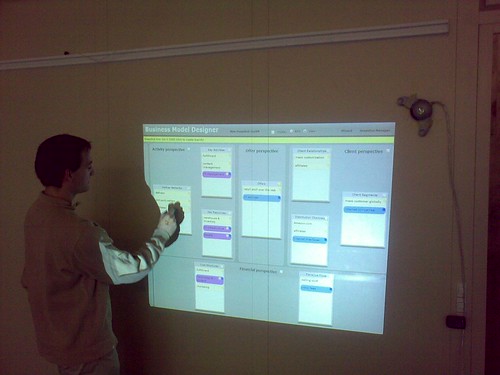
Yesterday he showcased the tool to me and Patrick van der Pijl, producer of my business model book. Boris built a web-based tool that allows the design and description of business models. But Boris didn’t keep it there. He extended the tool to allow designing business models live on a projected image on the wall (see picture where Boris works on a business model). How cool is that?

The tool, which is a research project, is still in private beta. We are currently exploring how it can most easily be used to build a database of interesting and innovative business models on the book chunk platform.

I think there is quite some potential in software-based business modeling. Two IBMers, Norbert Herman and Sergey Trikhachev are also working on a tool based on my method. They built a Visio-based tool and are extending it to include business model simulation capacities

Previously I called this Computer Aided Business Model Design (CABMoD), referring to Computer Aided Design (CAD) in Engineering and Architecture. I believe it has similar potential in business…

The Necessity of Management Innovation

Secret Blog
March 26, 2009 10:07 pm
You have subscribed to these e-mail notices about new posts to the blog.
If you want to change your settings or unsubscribe please visit:
?code=9f51710b1fb3a505ef2a446314e87b64&addr=traveladmatu.business%40blogger.com&

The Necessity of Management Innovation

Innovation regarding the way we run and manage our companies will be a key requirement to foster business model innovation. Financial Times management writer, Stefan Stern, and Peter Marsh wrote an excellent article on innovative management structures in the FT.

They portrait Terri Kelly, CEO of WL Gore, a .5bn turnover company, which is characterized by a totally flat organizational structure.

“Leaders emerge through a democratic process rather than being appointed from the top, and peer appraisal is crucial to both salary levels and career advancement.”

Ms Kelly makes a clear case for this type of “democratic management” that would probably steal most traditional managers’ sleep. She argues that decisions reached together are pursued much more energetically:

“I think that what you find in a lot of companies is that if there isn't true support for the decision, it gets undermined along the way. In fact, it may never come to fruition. So on the one hand you've made a very quick decision – 'We're going to go to China' – but then you've got all kinds of resistance."

Same goes for business model innovation. The lateral and multi-disciplinary nature of business model innovation projects require the motivation and true buy-in from all parties involved. Top-level support, while necessary, wont be sufficient to succeed.

A must read as to management innovation is Gary Hamel’s book “The Future of Management“. WL Gore is one of the examples which he explains in-depth. Others are Google, Whole Foods Market and Semco. Good Stuff. Gary Hamel has the merit of being the first “management guru” to raise awareness of this topic at the board level (read the NY Times book review).

Impressively, Gary Hamel, one of the most influentual management thinkers today, didn’t just leave it with writing a book. In June this year he gathered 30 leaders in management development, education, consulting, and the CEOs of Whole Foods, Gore, Ideo, Google, and HCL to discuss “the future of management”. He mobilized the crème de la crème of management thinking, such as Henry Mintzberg, C.K. Prahalad, Tim Brown, Peter Senge, … (too many gurus to mention them all). His gathering question was "why can't we bring as much innovation, adaptation, and engagement to our organizations as we do to our development of products and technologies?".

Read more about this event on David Sibbet’s blog.

Upcoming Workshops

Secret Blog
March 26, 2009 10:07 pm
You have subscribed to these e-mail notices about new posts to the blog.
If you want to change your settings or unsubscribe please visit:
?code=9f51710b1fb3a505ef2a446314e87b64&addr=traveladmatu.business%40blogger.com&

Upcoming Workshops

I have two public workshops coming up, besides my work for companies and conferences. It would be a pleasure to meet you there! There is an attractive “early bird rate” until December 19.

Public workshops:

  • 21. January ‘09: Zurich “Crafting Innovative Business Models” in German (info & sign-up here)
  • 22. January ‘09: Geneva “Crafting Innovative Business Models” in English (info & sign-up here)

Public Talks:

  • 15. December ‘08: VizThink Madrid - short keynote on business models and visual thinking together with XPLANE

Also, in April I will do another North America tour. Toronto and New York are sure stops. Others will be defined in the coming weeks.

Business Model Innovation Book - buy early access to raw content now!

Secret Blog
March 26, 2009 10:07 pm
You have subscribed to these e-mail notices about new posts to the blog.
If you want to change your settings or unsubscribe please visit:
?code=9f51710b1fb3a505ef2a446314e87b64&addr=traveladmatu.business%40blogger.com&

Business Model Innovation Book - buy early access to raw content now!

In May 2009 Yves Pigneur and I will bring a new management book to the market, which will be a beautiful manual for entrepreneurs and executives about business model innovation.

The interest we are getting for the book is staggering, because our business model innovation methods are already in use in companies such as IBM, Deloitte, Telenor and more. Our aim is to write a book that is visual & simple, applicable, relevant and full of exciting examples.

If you are interested in the topic you now have the exclusive possibility to get early access to the book content and a community of business model innovators. It is a unique opportunity to participate in the makings of a management book that has the potential to become a global bestseller. Working title: “Crafting Innovative Business Models” (ideas welcome).

We will float and discuss the book content as it emerges on www.businessmodelhub.com. Access will only cost you $US 24.- $US 36.- $US 54.- (the price increased because we exceeded 200 300 subscribers - it will rise again after 400 subscribers)

By joining you will have the following privileges:

  • first & exclusive access to raw book content as we write it on www.businessmodelhub.com
  • FREE digital version of the full book when it is published
  • opportunity to influence authors and join content discussions
  • personal mention of your participation (names of participants’ in print version in order of sign-up… so you better hurry ;-)
  • about 8 installments of book chunks (in a non-linear order as they emerge)
  • 50% discount off the final book
  • access to templates and exclusive PowerPoint slideshows
  • being part of the business model innovation community

When you buy access for $US 24.- we will invite you to the book chunk platform www.businessmodelhub.com within 48 hours. There you will be able to access everything that is going on. The first “book chunk” is due mid-December and is currently in the making. Already now there is a discussion on the book platform about examples, book format etc.

Don’t miss out on being part of a potential management book bestseller. You will even be able to prove it because your name will be mentioned in the print version!

On Monday January 19. 2009 at 17:00 (CET, Zurich/Geneva) we will hold a free webinar to explain how the book chunk project works.

Good PowerPoint Design - a strategic business tool

Secret Blog
March 26, 2009 10:07 pm
You have subscribed to these e-mail notices about new posts to the blog.
If you want to change your settings or unsubscribe please visit:
?code=9f51710b1fb3a505ef2a446314e87b64&addr=traveladmatu.business%40blogger.com&

Good PowerPoint Design - a strategic business tool

Have you ever “sold” a business project to your management or a venture to a financier? Did you ever happen to use PowerPoint or a similar presentation tool? Probably yes. Well, how much time did you invest in your slide deck? Were your slides beautiful?

Those are questions I now always ask my audiences in my keynotes and workshops on the topic of business model innovation. And most often people do not take PowerPoint seriously. However, they should. PowerPoint is a powerful weapon if used correctly! If used wrongly (as is the case for 90% of presentations) it is rather suicidal.

I attribute a substantial part of my success in my keynote speeches and workshops to my PowerPoint presentations. In fact, the design of my slide decks eat up a big part of my preparation time.

Here my learning as to “Good PPT-Design”, which I recently presented at a business incubator in Switzerland

Business Model Innovation, Big Companies and Creative Destruction

Secret Blog
March 26, 2009 10:07 pm
You have subscribed to these e-mail notices about new posts to the blog.
If you want to change your settings or unsubscribe please visit:
?code=9f51710b1fb3a505ef2a446314e87b64&addr=traveladmatu.business%40blogger.com&

Business Model Innovation, Big Companies and Creative Destruction

John Gapper wrote a very interesting opinion piece about Detroit's car industry in the FT this week (”Detroit tries to fool them again” on FT.com). He clearly outlines why he thinks the bailout of the car industry is questionable and how it is counterproductive for the overall industry. I couldn't agree more with him, because much of the car industry is an example of big business that failed to reinvent itself.

John argues that a bailout will…

  • reward failure
  • preserve chronic overcapacity
  • benefit the least efficient companies

It is not surprising that Detroit is calling for help. Most big companies have problems preparing themselves proactively for changing environments. An example I often cite is the music industries with its 4 major record companies. They are still struggling to adapt to the impacts of digital music.

Big companies' track record is particularly bad when it comes to business model innovation. In my workshops and keynotes I usually ask the audience which business models they find interesting and innovative. The examples that come up are almost always start-ups or very young companies (e.g. Skype, Google, MySpace, Zipcar, Kiva, no thrills airlines). And if you look at who founded the successful start-ups with innovative business models you will find quite a few that were created by people who had to leave the world of big corporations to implement their ideas (e.g. GoreTex by Robert W. Gore or EFG Bank by Jean-Pierre Cuoni and Lonnie Howell).

The question is then of course: is business model innovation possible within big companies? I do think so, since there are some good examples out there. Nespresso, part of the Nestlé group, disrupted the coffee market with its innovative business model. Procter & Gamble is reaching new heights with its new business model based on open innovation. However, it took Nespresso 30 years and a separate legal entity to succeed and P&G needed a big crisis to adopt change.

The most interesting recent example is maybe Nokia, the world's largest mobile phone manufacturer. They are currently transforming their business model from a manufacturer to a content company, which is selling music subscriptions and more along its phones. This is a substantial change from a business model based on transactions towards one with recurring revenues.

From my experience the telecom industry seems quite an exciting playground for business model innovation. In October I worked with Norway-based Telenor, seventh larges mobile network operator in the world with major operations in Asia and Eastern Europe and over 150 million mobile subscribers. I was surprised to discover that they had a unit called "business models" focusing on exactly that. It is part of a 200-person strong Research & Innovation (R&I) department and their staff is quite advanced in business model thinking. They look at new products & services and the corresponding business models for all of the markets they serve.

In July I worked with UNE in Columbia, a mid-sized telecom operator that is trying to integrate business model innovation more systematically into their operations. They will be using my business model canvas to format new initiatives.

A general conclusion from what I see in my workshops and keynotes is that there are some companies and industries that are already embracing business model innovation or at least want to learn about it, while some are still very reluctant (though rarely uninterested). Over time I think all companies will face the challenge of business model innovation and it is only a question of time when they start dealing with the issue.

As to Detroit’s car industry John Gapper sums it up nicely:

Perhaps the immediate cost of a Detroit bankruptcy is too high but the long-term effects would be beneficial.

Detroit must learn how to reinvent itself again. It will not be possible to save workers’ jobs over the long term with a bail-out - it must be innovation and creative destruction…

Thank You!

Secret Blog
March 26, 2009 10:07 pm
You have subscribed to these e-mail notices about new posts to the blog.
If you want to change your settings or unsubscribe please visit:
?code=9f51710b1fb3a505ef2a446314e87b64&addr=traveladmatu.business%40blogger.com&

Thank You!

I don't have a book, let alone a bestseller, and I am not faculty at a prestigious business school. Still, my approach to business model innovation is spreading around the world. People are interested in my thinking and I am getting more and more invitations to deliver keynotes and workshops globally.

This is only thanks to YOU, my audience, fellow business model thinkers, friends and people who have hired me. You are the ones spreading the word about my work, applying it and convincing others to join the thinking. Without you I could not undertake this journey to bring business model innovation management to another level. Thank you!

Thank you to those of you who have taken - and continue to take - the risk of hiring a "no-name” business speaker, simply based on the value you find in my work and my visibility on the web. Through your fees I can continue to advance business model innovation thinking.

Thank you to those of you who apply my work and customize it to your own particular needs and promote it in your organizations. You help improve and complete the inroads I tried to make in business model innovation.

Thank you to those of you who have helped me fill-up my workshops through your valuable business networks and your enthusiasm regarding business model innovation. Without you the seats would remain empty.

Thank you to those of you who read and comment on my blog and give me moral support. I need it to continue my journey towards the business model innovation book and ultimately a platform of like-minded peers who want to advance together and share their experience on business model innovation.

This journey is not easy, intellectually, stamina-wise and financially (despite my relatively high speaking/workshop fees). I only continue because of those of you out there who "read me", support me, challenge me and hire me. For me these are valuable indicators that show that we are onto something big. Together. As a community. I have the feeling we can create something big around this kernel of a business model innovation approach that I try to promote. I can't do it alone. I need you on this journey. Only if all of you help, can we make this a killer-approach that spreads globally.

Of course I have a self-interest in this success. But ultimately I am pursuing this because I am passionate about what we can bring to the world. If I were not, I would be working in a private bank in Switzerland and probably earning a comfortable and secure paycheck. But most important, I am stimulated by the growing community of users around the business model innovation approach that I launched.

Thank you for allowing me to continue developing the business model innovation approach. I see it a bit like open source software development. Together with Professor Yves Pigneur I launched a kernel and now hundreds of people are contributing to improving the business model innovation approach and thousands of people are using it…

Let us work together to make this something big! I believe together we can!

Google Book Search - first issue of my new business model innovation example series

Secret Blog
March 26, 2009 10:07 pm
You have subscribed to these e-mail notices about new posts to the blog.
If you want to change your settings or unsubscribe please visit:
?code=9f51710b1fb3a505ef2a446314e87b64&addr=traveladmatu.business%40blogger.com&

Google Book Search - first issue of my new business model innovation example series

During my d”aily lecture of the Financial Times I usually put on my “business model glasses” when it comes to the business section. Every week there are some very exciting examples of business model innovation. I decided to not only share these examples in my workshops, but also on my blog - hence the new “business model innovation example series”…

Enjoy the first issue on a deal that Google struck last week:

Book Chunk Project - prototype

Secret Blog
March 26, 2009 10:07 pm
You have subscribed to these e-mail notices about new posts to the blog.
If you want to change your settings or unsubscribe please visit:
?code=9f51710b1fb3a505ef2a446314e87b64&addr=traveladmatu.business%40blogger.com&

Book Chunk Project - prototype

Yves Pigneur’s and my book on the topic of “Crafting Innovative Business Models” (working title) is only due in May 2009 (approx.). That is way too long to wait. Many people asked us for early access. Hence, I thought it could be a good idea to distribute the book content in separate chunks before.

The slides below outline the draft of this idea of giving interested people early access to our writing for 24.- $US (or maybe a little more). By subscribing to this so-called “book chunk project” you will get several things (suggest more…):

  • first & exclusive access to raw book content
  • influence authors
  • x installments of book chunks (in a non-linear order - as we write them)
  • 50% discount off the final book (approx.)
  • participate in exclusive book chunk webinars
  • access to templates
  • being part of the business model innovation community

I would be interested in your comments on this and if you would be willing to buy such an early and exclusive access. Do you think the pricing is too low? Any suggestion is welcome. In the meantime have a look at the slides that outline this idea that I would launch very soon if I feel an interest from your side:

Book Chunk Project - prototype
View SlideShare presentation or Upload your own. (tags: book project)

Business (Strategy) Books Lack Creativity...

Secret Blog
March 26, 2009 10:07 pm
You have subscribed to these e-mail notices about new posts to the blog.
If you want to change your settings or unsubscribe please visit:
?code=9f51710b1fb3a505ef2a446314e87b64&addr=traveladmatu.business%40blogger.com&

Business (Strategy) Books Lack Creativity...

Today I did some research for my upcoming book with Prof Yves Pigneur: I went to a Border’s bookstore in New York and browsed the business (strategy) literature for their visuals and design. Basic conclusion: except for the cover there are no to little visuals, even for the most innovative book contents.

The most visual strategy illustration I found was in Kim & Mauborgne’s blue ocean strategy book. It is part of their concept to allow for a visual comparison of the differentiation strategy of a company. Though I do like their book, I believe it lacks the same visual creativity than all other strategy books.

As to their form & usability my conclusion is that the large majority of business (strategy) books are totally un-inspirational. So I moved on to architecture books, where I expected some great visual presentations. Of course architecture is more tangible than business (strategy). Yet, I don’t accept that excuse…


My nicest surprise during this little research was the discovery of a domain that makes great use of visuals: personal style. Look at the following photo & text. Wouldn’t that be a nice illustration when talking about customer strategies and “personas”?


The most notable exception in the field of business books was the one I bought. It’s called The Art of Engagement - Bridging the Gap between People and Possibilities. The author, Jim Haudan, uses illustrations extensively in his book and uses them as a tool for engagement… not surprising.

Though this lack of using visuals in business (strategy) books seems like a detail, I think it is essential when we are talking about strategy today. Strategies have to be communicated clearly. In today’s complex world this is only possible through visuals that simplify the complex and make it clear.

Visualization is also a technique that uses one of our most important senses - the ability to see. While it was difficult to include images in the early days of books, this is now different. Why are strategy gurus still not making use of today’s technology?

I hope I can change all this and bring in a fresh breeze… However, I’m still looking for the right designer, who can help us with our book ;-)